Media Reviews and More
After making a name for himself with the Ensemble Intercontemporain, Michel Arrignon continues to pursue a wide range of activities. His solo work brings dazzling light to every corner of the dignified Brahms solo. His clear style and effortless sound naturally capture the romantic melancholy. His Mozart performance, while contrasting with the gentleness of the Viennese style, is also eloquent and memorable. The solo exchanges with Japan's renowned Morgauer Quartet are also highly engaging. --Nobuaki Mitsuoka (CD Journal, July 2013)
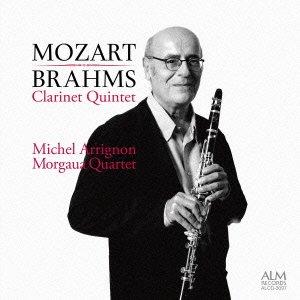
This is a live recording featuring France's renowned clarinet virtuoso, Michel Arrignon, and the thriving Morgauer Quartet. With Shostakovich at the core of their repertoire and a penchant for rock, the Morgauer Quartet is arguably one of Japan's most distinctive string quartets. Here, however, they modestly tackle two classic classics.
At the time of this live performance last October, Arrignon would have been well over 60 years old. Yet his first-rate talent remains intact. Even playing two major pieces by Mozart and Brahms on stage, he shows no signs of stamina. However, his recent shift toward exploring musical flavor over technique is perhaps a natural progression of his years. In Mozart, his greatest strengths lie in the dreamlike nuances of his tone, as heard in the Larghetto theme in the second movement and the Adagio in the final movement. The members of the Morgauer Quartet gently accompany this veteran, remaining in the background to ensure the lead role remains. I like the lack of oppressive perfectionism in the ensemble.
This Mozart performance isn't particularly feminine, but the Brahms piece is far more masculine. While the overall performance lacks emphasis on the seriousness or loneliness of the piece, it could be described as bland in some ways, but I believe that its understatedness is precisely what gives it its unique value. --Masazumi Oki (Record Geijutsu, August 2013 issue)
In Mozart's A Major Quintet, Arrignon's performance freely changes dynamics and tempo, bringing a sense of free-flowing emotion and making full use of the manager's influence. The second movement, "Larghetto," in particular, unfolds a sense of both calm and free-flowing emotion. Arrignon's performance here is truly captivating and full of flavor, and the beautiful tone of the strings blends beautifully with the soft resonance of the clarinet.
Arrignon's performance of Brahms' B minor Quintet is similarly free-flowing and poised, yet without the "heaviness" often associated with German-speaking musicians, resulting in a clear impression in each movement. Arrignon's performance of the long melody, delivered in one go and without any rushing, is perfectly suited to the piece's image. The clarinet and string ensemble are also tightly integrated, with their performance most effective in the second movement. Arrignon's technique is truly solid, and his free-flowing transitions in tempo and dynamics beautifully express the piece's delicate emotions. --Akira Takahashi (Record Geijutsu, August 2013 issue)
Synopsis
[The pinnacle of clarinet performance and the most powerful quartet]
October 1, 2012. On the night that record-breaking Typhoon Hagibis left Tokyo, Kioi Hall was once again engulfed in a storm. This time, however, it was a storm of emotion.
Michel Arrignon, a French brass instrument luminary, came to Japan from France and served as principal player of the Paris Opera Orchestra and professor at the Conservatoire National de Paris after serving with Boulez's Ensemble Intercontemporain. The Morgaud Quartet, comprised of top musicians from Tokyo-based orchestras, consistently attracts attention for its wide range of music, not just classical.
The music created by these two masters, both Japanese and French, who master a wide range of music from classical to contemporary, despite the uncertainty surrounding concerts, is incredibly exciting!
CD Journal Recommended, Record Art Semi-Special Selection, Record Art Excellent Recording
About the Artist
[Michel Arrignon (Clarinet)]
He graduated from the Conservatoire National de Paris with Premier Prix awards in clarinet and chamber music, and continued his studies at the University of Michigan in the United States. He won second place at the 1972 Geneva International Music Competition. From 1978 to 1983, he was a member of the Ensemble Intercontemporain, led by Pierre Boulez. From 1984 to 1989, he served as principal clarinetist with the Paris Opera Orchestra. From 1989 to 2009, he succeeded Guy Deplus as professor at the Paris Conservatoire. In 2010, he was appointed professor emeritus at the Reina Sofía Conservatoire in Spain, a position he holds to this day.
As one of France's leading clarinetists, he possesses a wide repertoire, ranging from pre-Mozart works to contemporary music. His superhuman technique and interpretation of contemporary music are renowned, and many renowned composers have dedicated works to him. In addition to his active performance career, he has also made numerous recordings. He has also been invited to give seminars around the world, and is passionate about nurturing the next generation of clarinetists.
Former professor at the Paris Conservatoire and professor emeritus at the Reina Sofía Conservatoire. Visiting professor at Osaka College of Music. Resident tester at the Buffet Crampon Mantle Factory.
[MORGAUA QUARTET]
- First Violin: Eiji Arai (Solo Concertmaster, Tokyo Philharmonic Orchestra)
- Second Violin: Tetsuo Tozawa (Concertmaster, Tokyo City Philharmonic Orchestra)
- Viola: Fuji Ono (Second Violist, NHK Symphony Orchestra)
- Cello: Ryo Fujimori (Principal Cellist, NHK Symphony Orchestra)
MORGAUA QUARTET was formed in the fall of 1992 to perform Shostakovich's 15 string quartets. The quartet held its first regular concert in June of the following year, and since then, the quartet's innovative programs and performances that get to the heart of the music have consistently attracted attention and enthusiasm.
In January 1998, they received the 10th Muramatsu Award. In April 2005, they released Borodin: String Quartets from Meister Music. In May 2011, they received the 2010 Arion Award. In June 2012, they released the progressive rock album Mentally Normal in the 21st Century from Nippon Columbia. They have received high praise as a borderless string quartet.
The name "Morgŭa" comes from the Esperanto word morgaŭa, meaning "tomorrow.


 No-delivery refund


![[SHM-CD] Clarinet Quintet Mozart K581 Brahms 115 OBI Karl Leister UCCS-50151 NEW](https://img.joomcdn.net/81954711134d0acc0524776dce86d9872ee583da_100_75.jpeg)