Book introduction
"Why do Koreans say 'no' first?"
"I want to understand the lines that my favorite actor Park Bo-gum said in the drama."
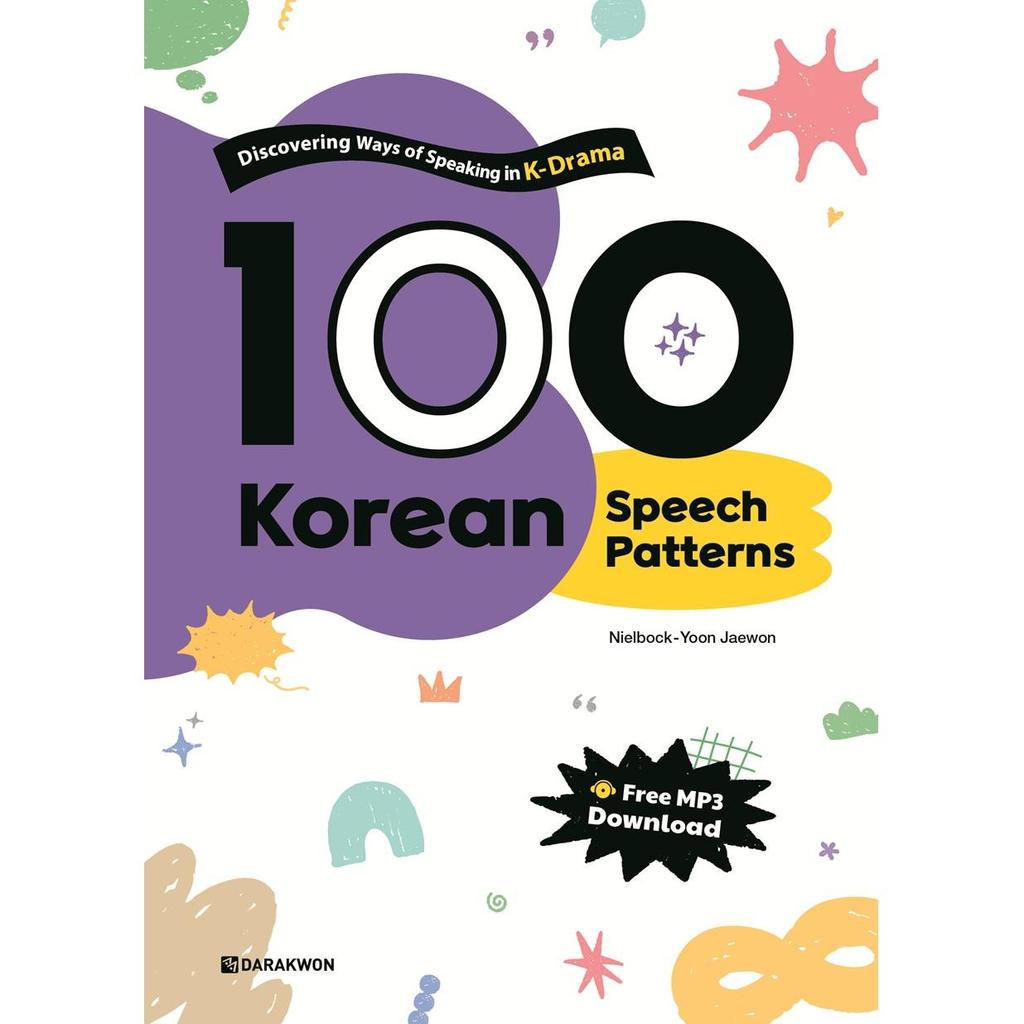
As a follow-up to the series 100 Korean Idios & Slang for Korean learners interested in K-Culture, 100 Korean Speech Patterns will be published to learn 100% vivid real Korean through the expressions featured in K-Drama.
100 Korean Speech Patterns analyzed Koreans' representative speech habits based on the lines in K-Drama for intermediate or higher Korean learners and composed of 50 expressions and 50 sentence patterns. Each expression and sentence type was designed to intuitively understand the context through illustrations based on actual drama scenes, and the learner was designed to infer the meaning first through a simple quiz. In the following explanation, the meaning and use of expressions and sentence patterns are presented in detail, and various contexts of use can be learned naturally through dialogue examples composed like lines in a drama.
In addition, the voice of a professional voice actor is provided in MP3 files so that all expressions, examples, and lines in the drama can be heard directly, and learners can read along the sound source as if acting like an actor and practice pronunciation and accent together.
Publishers Review
▪ 'Real' Korean Speech Habit Learning from Drama Lines
The expressions and sentences contained in the book all start from a scene in a Korean drama. A drama is a story, but the way of speaking and communicating in it is reality itself. "100 Korean Speech Patterns" helps you naturally learn the temperature, timing, and nuances of speech that cannot be grasped only by grammatical explanations by following the context of the scene. As soon as you understand "why you use this word in this situation," you begin to hear Korean much more clearly.
▪ Illustration – Quiz – Explanation – Conversation Practice, step-by-step learning to learn naturally
Each unit opens with illustrations and lines based on a drama scene. First, look at the scene, guess the situation, and then guess for yourself the meaning and use of the expression with a short quiz. In the following explanation, the core points of expression and sentence patterns can be pointed out, and various contexts of use can be confirmed through actual dialogue examples. In addition to this, the voice of a professional voice actor provided by a QR code is added, so that you can practice conversation with an accent and a sense of speech alive.
▪ Expression 50 + Moon Hyung 50, 100 speech habits used immediately in conversation
"100 Korean Speech Patterns" consists of two parts in total.
Part 1 deals with 50 expressions of speech habits that Koreans often use in their daily lives, such as "You know," "Honestly," "No joke," and "Don't bother," while Part 2 deals with 50 speech habits that frequently appear in real conversations, such as "I quit," "I said, "I had no choice but to do so," and "I had no choice but to do so." At the end of the volume, it contains the correct answer to the quiz, translation of lines, and explanation of meaning, as well as the K-Drama index and expression and sentence index, which are also useful for repetitive learning and reference.
** INDEX **
•머리말 Preface 2
•일러두기 How to Use This Book 4
•차례 Table of Contents 8
PART 1 말 습관 표현 Speech Expressions
1 있잖아 You know… 14
2 저기요 Hey there… / Excuse me… 16
3 미안하지만 / 죄송하지만 Sorry, but… 18
4 가만히 있어 봐 Hold on / Wait 20
5 개인적으로 Personally… 22
6 솔직히 Honestly… / To be honest… 24
7 아니 No / Uh 26
8 그러니까 So… / In other words… 28
9 그런 것 같아 It seems like that… / I guess so… 30
10 그치? Right? / Isn’t it? 32
11 정말? Really? 34
12 아깝다 What a shame/waste 36
13 뭐랄까 How should I put it…38
14 대박! Awesome! / Wow! 40
15 짜증나 I’m annoyed 42
16 헐 Whoa / Oh my god 44
17 말도 안 돼 No way / Unbelievable 46
18 그렇긴 한데 That’s true, but… 48
19 완전 Total(ly) / Complete(ly) 50
20 뭐라고? What did you say? 52
21 아무튼 At any rate… / Anyway… 54
22 당연하지 Of course 56
23 글쎄 Hmm… / Well… 58
24 어쩌라고? So what? 60
25 어쩔 수 없지 It is what it is / It can’t be helped 62
26 그렇구나 I see 64
27 뭔가 Something… 66
28 지금? Now? 68
29 설마 No way / You can’t be serious 70
30 혼나다 Almost died… 72
31 약간 A bit… / Slightly… 74
32 그거 알지? Do you catch my drift? 76
33 내가 할게 I’ll take care of it / I’ll do it 78
34 그럴 거야 It most likely will… / Probably… 80
35 뻔하지 I knew it / It’s obvious 82
36 장난 아니야 No joke / Seriously 84
37 뭐 하자는 거야? What are you trying to do? 86
38 그만해 That’s enough / Stop it 88
39 당장 Right away / Immediately 90
40 왜 그래? What’s the matter with you? 92
41 이게 뭐야? What’s this? 94
42 됐어 It’s fine / Forget it 96
43 알았어 Okay / I got it 98
44 너무해(요) That is too much/so mean/unfair 100
45 신경 쓰지 마 Don’t worry about it 102
46 –지 뭐 Happens though 104
47 대충 Roughly / More or less 106
48 나도 그래 Same here / Me too 108
49 그냥 Just… / Simply… 110
50 느낌이 이상해 Something feels off 112
PART 2 말 습관 문형 Speech Patterns
51 같은데 I think / It seems like… 116
52 -(으)ㄹ 걸? I guess… / Probably… 118
53 –길래 As… / Because… 120
54 -(으)ㄴ/는 거 아니야/아니에요? Isn’t this…? / Aren’t you…? 120
55 –더라고(요) I noticed/realized... 124
56 –게 됐어 I ended up… / It turned out… 126
57 -잖아(요) (I told you/You told me...) right? 128
58 –고 말았어 I end(ed) up… 130
59 –는 중이야 I’m in the middle of… / On the way… 132
60 –나 봐 I guess… / It seems like… 134
61 -(으)ㄹ래? Do you want to…? 136
62 -(으)ㄴ/는 것 같아 It seems like… / I think… 138
63 –게 So that… 140
64 -(으)ㄹ 뻔했어 I almost (didn’t, couldn’t, etc)… 142
65 -(으)ㄹ 테니까 So… / Since… 144
66 -(으)ㄹ지도 몰라 It might be… / I don’t know, maybe… 146
67 -기만 하면 Whenever… / As long as… 148
68 –았/었으면 좋겠어 I wish… / I just hope… 150
69 -(으)ㄹ 거야 I’ll make sure… / I’m going to… 152
70 –았/었더라면 If I had… 154
71 –지 않을까? Don’t you think…? / Maybe it will… 156
72 -고 나서 Then… / After… 158
73 –다가 While… 160
74 -(으)ㄹ 만해 It’s worth doing… 162
75 –자마자 As soon as… 164
76 -(으)ㄴ/는 편이야 Tend to be… 166
77 -(으)ㄴ/는 척하다 To pretend… 168
78 -(으)ㄹ 리가 없어 There’s no way… 170
79 -(으)ㄴ 적 있어? Have you ever… 172
80 -는 게 낫지 않아? Isn’t it better…? 174
81 –기도 하고… Also… / Both… and… 176
82 -(으)ㄹ 수밖에 없어 Can’t help… / It’s inevitable… 178
83 -(으)ㄹ 필요가 없어 No need to… 180
84 –거든(요) Actually… 182
85 –아/어도 돼? Is it okay/fine…? 184
86 –기 싫어 To not want to… 186
87 –았/었어야 했는데 Should have… 188
88 –더니 As a result… 190
89 -(으)ㄴ/는가 보다, -나 보다 Looks like…, I guess… 192
90 -(으)ㄹ까 봐 To be worried/afraid… 194
91 –기로 했어 Decided to… 196
92 –는 바람에 Due to… (negative consequence) 198
93 (-(으)ㄴ/는) 덕분에 Thanks to… 200
94 -(으)면 할수록 The more ..., the more... 202
95 –고 싶어(요) Want to… 204
96 이/가 아니라 It’s not… but… 206
97 -(으)려고 In order to… / Planning to… 208
98 –아/어도 Even if… / Even though… 210
99 -(으)ㄴ/는 대로 As soon as… / According to… 212
100 –는 동안에 While doing… 214
Appendix
• 퀴즈 정답 Quiz Answers 218
• 대사 번역 Script translation 222
• 의미와 사용 한국어 설명 Meaning & Use in Korean 229
• K-Drama 색인 Index of K-Drama 246
• 100개 말 습관 표현/문형 목록 Alphabetical Index of 100 Expressions & Patterns 249
Introduction of the author
Yoon Jaewon
Doctor of Multilingualism, University of Cologne, Germany
Master of Language and Culture, University of Maryland (UMBC) in the United States
Full-time Professor of Korean Studies at Ruhr Bochum University, Germany
a lecturer in English education at the University of Cologne
a book
100 Korean Idioms & Slang - Discovering the Origins of the Words in K-Pop, 다락원, 2024, 공저


 No-delivery refund